ShopDreamUp AI ArtDreamUp
Deviation Actions

----CONTAINS SPOILERS!!----
Intended for readers who have finished watching season 1 of The Legend of Korra.
If you hate spoilers, do NOT read until you've watched the entire series.
You have been warned.

Exploding through her family's hut, brazenly wielding elements far beyond her age-level, wildly announcing that, yes, she IS the new avatar and the world better get used to it. Now here's an avatar so unlike Aang! One who depends solely on herself, resorts to brute force to solve her problems. Yes, creators! Give us skill, power, conceit, and spiritual neglect. Let it blow up in her face, forcing her to cope with the fact that confrontation can’t solve everything. Just as Aang learns too little power is detrimental to his avatar role, so too will Korra learn the same lesson about too much power.
This is the dynamic, juxtaposed character arc I expected avatar Korra to undergo during her series.
-cue wah wah waaaah and laughing sound clips-
…Yeeeaaah.
At the beginning of the season, we have a brash, over-confident bully.
And what do we have at the end?
A brash, over-confident bully.
Korra lacks growth. Yes, things happen to her, and yes, she reacts to these things, but nothing changes. Not her opinion of herself, not her outlook, not her approach. She never acknowledges her shortcomings, which makes the series appear to condone them.
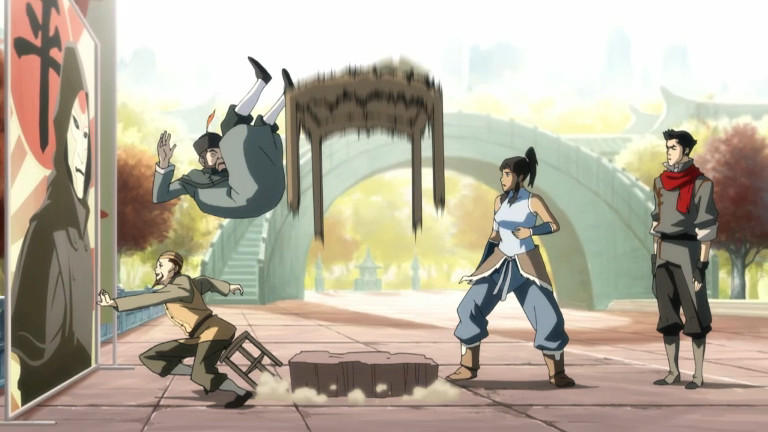
"No objections here, flyer distributors are the scum of the earth, right?"
And it’s not only Korra. Lack of growth seems to be an ongoing theme--Mako shifts from a somber, responsibility-ridden provider to a robot droning "I love you" left and right, Bolin the humor-wielding peace-keeper to… wait, what's he been doing the second half of the season again? And Asami, who didn’t quite have a clear direction, delegated to a jealousy role. Stuff happens to the characters, a few kisses are exchanged, but nothing of great consequence is revealed about them throughout the 12 episodes.

"Meanwhile, I'll humor your suspicions instead of telling you to stfu and help find my possibly dead love interest."
And character is only half of a good story--the other is plot.
The Legend of Korra has great plot points.
Pacing absolutely destroys them.
This series is, to put it kindly, end-heavy. All the plot has been shoved into the last few episodes. Imagine the dynamics that would have naturally followed if say, the revelation of Tarrlok's blood connection to Amon was spread backwards into earlier episodes, or his motives behind protecting the city--enough conflict for a whole season, maybe even two. But the writers felt our time was better spent on pro-bending matches and love triangles.

"Hey Korra!! Let's go to the next plot point!"
12 episodes is not too short a time to tell a story--tons of series do it all the time, and quite well. Length doesn't make or break a story, decisions about how to command that length does. The Legend of Korra is fraught with poor pacing decisions--the biggest one being over-budgeting the amount of time dedicated to events of little consequence. In turn, the later events are rushed, thus cheapened. How Korra finally reaches the avatar state, I think, sums up this cheapening effect well: by feeling sorry for herself.

"It was absolutely horrible, only being able to bend one element?? You can’t even imagine!"
Overall The Legend of Korra is a story that falls quite flat considering the potential inner conflict within Korra, and the complex social issues that front her city's problems. Especially regretful is the lack of multiple perspectives on the struggle between benders and non-benders, the ignored driving force behind the entire plot. Instead, we are expected to side with Korra, her friends, and the benders on principle, which isn't enough in any form of storytelling.
big Rontu update
I'm amazed it's been 5 years since I last uploaded on this site on a regular basis. after 2015, I only posted a couple drawings a year. I'll explain the reason in this journal, and also just share some life updates from 2016 to just about a month ago, I've been too ashamed to admit that I experience carpal tunnel symptoms when I draw any longer than a few hours. only in retrospect have I realized how silly it is to feel like I need to hide something like that. creating art is so fun and fulfilling to me, so when that activity started to cause me physical pain and prevented me from doing it, I guess I didn't know how to deal with it emotionally last month I experimented with changing my habits. I tried out drawing for just 20 minutes at a time, taking a 10 minute break, then drawing for 20 minutes again. and it worked! I didn't experience any wrist issues. yeah it's kinda tedious, but it felt amazing to be able to draw a big art piece again! (the pokemon trainer poster) I'm feeling
Sonic Glitch Rift Chapter 35! (Final Chapter)
My Sonic fic is officially complete as of tonight! Here is the final chapter. Knuckles jerked awake. He was laying in the dark. Half-asleep. The thoughts in his head felt strange and muddled, until he recognized the smell of fresh dirt. Then he remembered. He was inside an underground tunnel. One he had dug himself. At his side, the purple Super Emerald was glowing, safe and peaceful. Something grabbed his arm. Knuckles shot upright and threw a punch. “Hey!! It’s me!” a small voice protested. Knuckles squinted through the light pouring through the tunnel’s entrance. Two silhouettes stood waiting there. He shielded his eyes and groggily asked, “…Amy Rose? Tails?” “Yep! It’s time to wake up,” Amy chirped. “We’ve been waiting forever! And we have something special to show you.” The children hurried Knuckles along by both of his hands. They led him out of the forests of Aquatic Ruin and onto the rolling plains of Emerald Hill. He followed along in confusion. The walk continued on
Sonic Glitch Rift Chapter 34!
Sonic and the others slowly emerged from the mouth of a cave. Rays of sunlight spilled over the last of the stalactites that hung over them. They were above ground now. And stretched out before them was green. Green, striped, rolling hills. Pristine and right. Without a trace of glitching. Smiles shined on everyone’s faces. Amy’s was biggest of all. She hopped up and down, and spun around to face everyone else. “It’s West Side Island?? I know where we are!” She faced the hills again and dashed forward. “Come on, everyone!” The small animals followed behind with glee. Sonic stayed and watched the others fan out over the hills. The grass looked so vibrant. So bright against the deep blue sky. But more than that, the world felt right again. Nature stood before him, wild, and free, and beckoning. A breeze drifted in. Sonic closed his eyes. Gently, it filtered through the gaps in his spines. It cooled the warm touch of the sun on his fur. He took in a breath of the fresh air. Then,
Sonic Glitch Rift Chapter 33!
Knuckles was knelt in the grass. Beside his knee lay Mecha Sonic’s dismantled turbine. Purple energy smoldered over its surface like the gentle flame of a candle. The red gemstone at its center crackled with electricity. Knuckles placed his hand upon it. A hot twinge shot through his palm. But he only closed his eyes, and called out to the Chaos Emerald trapped within. Elsewhere, in the sacred, abandoned, underground palace, Sonic stood in place. Eyes closed, hands on his chest. Remembering the words Knuckles had told him moments before. “To succeed, you can think of nothing else,” Knuckles had told him over the communicator. “You must concentrate. The Chaos Emerald, is in a state of duality.” Duality. That word sparked something within Sonic. A fleeting memory of a tarot card, and of Amy’s shining eyes. Knuckles continued, “It cannot connect back to its Super Emerald while it remains in this state… It’s trapped between you and Mecha Sonic. Two places at the same time. The
Featured in Groups




© 2012 - 2024 rontufox
Comments88
Join the community to add your comment. Already a deviant? Log In

I agree with almost everything you wrote, except that Asami didn't act as jealous as a lot of girls would have in her situation. Also, what jealousy and suspicion she did show were entirely justified, because Mako did waffle back and forth between her and Korra. But maybe I'm being overly defensive of Asami because she was unfairly maligned by a large portion of the fanbase. I'll grant you that she did lack a clear direction and motive.